

Honoring the Leather Community: Activism, Identity, and the Journey Toward Freedom
More Than Meets the Eye
The leather community has often been reduced to a single idea in the public imagination. Many people see the leather scene as something centered only on fetish or nightlife. What often gets overlooked is the depth of the people who built this culture and the ways they shaped LGBTQIA+ history long before many of us were even born. The leather community has always held more than one truth at a time. Yes, it celebrates desire, but it also celebrates discipline, chosen brotherhood, service, mentorship, heritage, and a kind of freedom that has always pushed against the walls placed around queer lives.
What has become clear as I have grown into my own identity is that the leather community is made up of people who carved out space for others long before the world was willing to make room for us. They raised money during the AIDS crisis when elected leaders chose silence. They offered guidance to younger queer people who did not have anyone else to turn to. They created codes of respect and responsibility that helped many find belonging. They kept our history alive when much of society tried to erase it.
My own connection to this community came in unexpected moments. It came through the stories of people I respected, like a former boss who was a Mr. Leather titleholder and also a trusted professional in a nonprofit setting. It came through my experiences in Key West where I stepped into a leather shop off of Duval Street for the first time and felt something inside me open. That journey showed me that leather is not about a single stereotype. It is about self expression, heritage, and the way a community can teach you to breathe in your own skin.
This story begins with a simple goal. I want to help readers see the leather community with a wider lens and understand its influence on queer resilience, culture, and activism. I also want to honor the people who have shaped this community through courage, leadership, humor, creativity, and sometimes through heartbreak. This is a story about visibility, about care, and about the many ways queer people have taken care of each other when no one else would.
Cultural Cornerstones of the Leather Community
The leather community did not appear out of thin air. It grew from specific moments in history, from the people who lived through them, and from the need to create spaces where queer folks could exist with honesty and safety. Understanding these roots helps us appreciate why leather culture became such an enduring part of LGBTQIA+ life.
The Rise of Leather Culture in LGBTQIA Plus History
Leather culture began to take shape after World War II. Many gay men returned from military service with a sense of camaraderie and masculine expression that did not fit into the expectations of American society. They had lived through intense bonds, shared danger, and rigid discipline. Once home, they found a world that still wanted them hidden and silent. Leather bars and clubs grew as safe places where they could reclaim both identity and physical presence without apology.
Post War Identity and the Search for Belonging
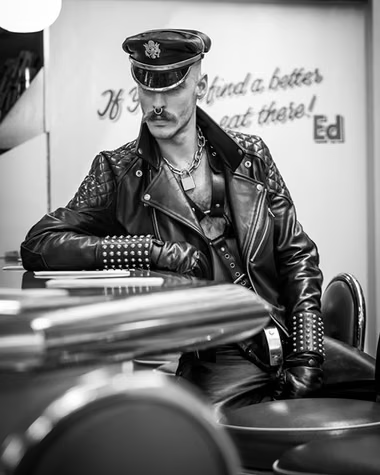
For many, leather became a way to express strength and solidarity. It was a response to a society that viewed queer men as weak or deviant. Leather signaled pride at a time when open pride could cost someone everything. The look itself became a kind of armor, a symbol of community, and a language of its own.
Community Codes, Signals, and Shared Language
Inside those bars and gatherings, the leather community developed signals and traditions that helped people connect with respect and clarity. There were expectations around consent, safety, and communication. These early codes helped set standards that continue to shape modern kink and BDSM communities today. They were created not only for pleasure, but also for protection in a world that was not protecting queer lives.
Iconic Events and Celebrations
As the community grew, so did its celebrations. Leather organizations began hosting contests, festivals, and gatherings where people could come together across cities and countries. These events became central meeting points in queer history.
The Folsom Street Fair
Folsom Street Fair in San Francisco is now one of the largest leather and kink gatherings in the world. What started as a street fair to support local businesses in the eighties became a landmark event that celebrates freedom, body autonomy, and queer visibility. It is equal parts festival, fundraising engine, and community reunion. It gives people the chance to show up in their truth, surrounded by others who understand the power of doing so.
International Mr. Leather
International Mr. Leather, often called IML, began in 1979 and quickly became one of the most recognized events in the leather world. It brings together contestants and community members from across the globe to honor leadership, service, humor, authenticity, and community involvement. The title is not only about aesthetics. It is about representing the community with pride and contributing to its continued strength.
Key Figures, Elders, and Institutions
Leather culture has been shaped by countless individuals whose work, writing, and leadership have made lasting impact.
The Leather Archives and Museum
The Leather Archives and Museum in Chicago is one of the most important institutions preserving LGBTQIA plus history. It houses stories, artifacts, artwork, and personal collections that might have been lost forever. The archive protects the legacy of leather and kink communities and ensures future generations can learn from the people who walked these paths before them.
Influential Voices
Writers and educators like Guy Baldwin, Hardy Haberman, and others also helped shape the conversation around leather culture. Their work explored topics like psychology, consent, ethics, relationships, and the emotional complexities of power exchange. They gave language to experiences many people did not know how to articulate.
A Personal Connection to Leadership
Professionalism and Passion Coexisting
My own introduction to this dimension of the community came through someone I respected. A former executive director I worked with held a Mr. Leather title. What struck me most was how seamlessly he balanced leadership in a nonprofit setting with the joy he found in his connection to the leather world. It was not a performance or a secret. It was simply a part of who he was, and he navigated it with honesty and integrity.
What His Openness Taught Me
He showed me that queer identity is allowed to contain multitudes. A person can be a respected professional, a community advocate, a mentor, a friend, and someone who finds meaning in leather culture. His example helped me understand that leather is not a separate world. It is part of the wide spectrum of ways queer people build community, connection, and pride.
If you’re enjoying this article, please consider supporting us on Patreon!
Your support helps keep this space free and available, click here to learn how.
Activism and Community Care
The leather community has always been more than a social scene. It has been a place where people cared for one another during some of the darkest chapters in queer history. When the AIDS crisis began tearing through LGBTQIA plus communities in the early eighties, many institutions remained silent or refused to help. The leather community did not. They stepped forward with urgency, compassion, and courage, creating systems of support that filled the gaps left by a country that was looking away.
The Leather Community During the AIDS Crisis
Fundraising Leadership
Leather bars, clubs, and organizations quickly mobilized when the scale of the epidemic became clear. They raised enormous amounts of money through contests, auctions, dance nights, raffles, and street fairs. These efforts supported people who were sick, funded research, helped cover medical bills, and sustained the early AIDS service organizations that eventually became national lifelines.
Fundraising was not a side activity. It became a regular part of leather culture. It brought people together in solidarity and created a sense of purpose in a time marked by fear and grief.
Caregiving, Buddy Programs, and Volunteerism
Many members of the leather community stepped in as caregivers when people were abandoned by families or dismissed by hospitals. They helped with meals, transportation, cleaning, medication schedules, and emotional support. They sat with people who were dying so they would not have to die alone. They created buddy systems to ensure no one fell through the cracks.
These acts of care were quiet but powerful. They were born from a culture that had already learned how to look after one another through shared trust, structure, and chosen family.
Standing Up When Others Looked Away
It is impossible to talk about the AIDS crisis without acknowledging the bravery of the people who refused to be silent. Many members of the leather community participated in protests, advocacy, and political action. They helped build the momentum behind groups like ACT UP, supported early marches, and challenged the government to recognize the crisis.
Their visibility mattered. Their presence mattered. Many were leaders in the fight for resources and dignity at a time when society tried to erase queer people entirely.
How Leather Culture Strengthened LGBTQIA Plus Activism
Rapid Mobilization and Community Structure
The leather community already had strong networks and organizational skills through its clubs, contests, and bars. When the crisis hit, those structures allowed them to respond quickly. They knew how to communicate across cities, how to raise funds, how to show up in groups, and how to take care of their own. This foundation helped save lives.
Bars, Clubs, and Contests as Fundraising Engines
Events that once focused on celebration quickly adapted to meet the needs of the community. Titleholders used their platforms to raise awareness and money. Bars held benefit nights every week. Clubs organized volunteer groups. The leather community used everything they had to support one another.
Brotherhood and Mutual Aid
Support within the leather community often felt like family. Many people who were rejected by their families of origin found belonging among leathermen and leatherwomen. The discipline, tradition, and ethic of care that defined leather culture played a major role in holding the queer community together during years of heartbreak.
The Role of the Daddy: Patronage, Mentorship, and Care
Beyond Sexuality
While many people outside the community associate Daddy roles with erotic dynamics, the internal meaning often runs much deeper. A Daddy is frequently someone who offers guidance, steadiness, and emotional grounding.
Protectors, Mentors, and Elders
Daddies often serve as teachers for younger or new members. They offer advice on safety and communication. They pass down history and traditions. They help create the sense of belonging that so many people look for when they arrive in queer spaces for the first time.
Why These Roles Strengthened Community Survival
During the AIDS crisis, and even before it, these mentorship roles created strong support networks. They helped people navigate fear, grief, desire, identity, and community life. It was not unusual for Daddies to fill roles that families or institutions refused to fill. In many ways, the structure of the leather community helped lay emotional and practical foundations for survival.
Personal Journeys and Self Discovery
The leather community is not only a historical force. It is a living presence that continues to shape the lives of people who encounter it. For many, these encounters are turning points. They can open doors that once felt permanently closed and help people step into versions of themselves they did not know they were allowed to become. My own experiences with leather came at a time when I was still learning who I was and what freedom could look like. These moments helped me understand not only myself, but also the depth of the community that welcomed me.
Key West: The First Taste of Freedom
Walking into the Leather Shop off of Duval Street
I still remember the feeling of walking into that small leather shop in Key West. I had never been inside a store like it before. The walls were covered with harnesses, boots, straps, and pieces that felt like symbols of courage. I chose a harness, a mask, and a pair of underwear that made me feel powerful in a way I had never felt before. They were not just clothing. They represented something I had been missing for most of my life. They represented permission.
Fantasy Fest and Radical Liberation
Wearing those pieces at Fantasy Fest was a moment of transformation. The streets were full of people celebrating life, color, and expression without judgment. I felt seen. I felt whole. It was the freest I had ever felt. It was the first time I understood that freedom is not simply the absence of burden. It is the presence of possibility. That night helped me imagine a life where I did not have to shrink or hide.
Realizing I Could Build a Life Where I Belonged
That experience changed me. I left Key West with the belief that I could create a life that matched who I was inside. It was more than a vacation. It was a vision of what my life could be if I followed my own truth. The leather community was part of that realization because it showed me that strength, vulnerability, and authenticity can all exist in the same space.
Escaping the South: A Life Defined by Constraint
Religious Shame and Societal Confines
Growing up in the South meant carrying messages that were meant to silence me. I learned early that being queer was something people wanted to hide. Religion told me I was wrong. Community told me I was unsafe. There was no space to breathe. No space to grow. No space to become.
Why Key West Felt Like a Doorway to a New Life
Key West felt like sunlight after years of darkness. It felt like a place where joy was not a secret and where self expression did not require apology. It offered something the South had never given me. It offered room to imagine my own life, free from the fear that had shaped my childhood. Want deeper context? You can find it in the story of my upbringing, where I wrote about growing up queer and homeless in the South. That part of my past explains why Key West felt like a miracle, even with the challenges that followed.
The Hard Truths: Key West Was Not Easy
Job Competition and Economic Reality
As liberating as Key West was, it was also incredibly difficult. The job market was flooded with people who wanted to live in paradise, and competition for work was fierce. Every application I submitted was met with long lines of other hopefuls. No matter how hard I tried, I could not find stable work there. It was humbling. It was frustrating. It was real life pushing back in a place that had otherwise felt like freedom.
Returning Home
Eventually, I had to return back home. Leaving Key West felt heartbreaking, but it was not a failure. It was simply a turn in the road. The experience had already changed me. The freedom I felt there came home with me. It shaped how I saw myself and how I moved through the world. Even when life pulled me away from the island, the lessons stayed.
Love, Honesty, and Divergent Paths
My Boyfriend’s Story and the Weight of Where We Were in Life
At the time, I was in a relationship with someone who was undocumented. We cared for each other, but the circumstances were difficult. The laws were not on our side. Marriage equality was not yet a reality. He had to make choices for his own safety and survival, and those choices took him down a path that did not include me.
Honesty Without Betrayal
There was no betrayal in our story. He was honest with me throughout. He showed me care, kindness, and respect. Our relationship ended not because of failure, but because life demanded decisions that neither of us could avoid.
Why This Belongs in the Larger Story
This moment matters because queer history is full of stories shaped by outside pressures. Legal systems, borders, and cultural expectations have shaped who we love and how we love. My experience reflects a reality many in our community have faced. It is part of the truth of coming into ourselves in a world that does not always make room for us.
The Larger Impact of the Leather Community
The leather community has shaped queer culture in ways that many people do not realize. It has influenced how we express ourselves, how we build support networks, and how we show up for one another. The impact goes far beyond clothing or nightlife. It reaches into activism, visibility, and the way LGBTQIA plus people claim space in the world today.
How Leather Culture Shaped LGBTQIA Plus Liberation
Visibility, Body Autonomy, and Defiance
Leather has always challenged the idea that queer people should be quiet, hidden, or acceptable only when meeting certain expectations. By embracing strength, erotic expression, body confidence, and bold self presentation, the leather community pushed back against the pressures of respectability. They showed that liberation requires the right to be fully oneself, whether the world approves or not.
Their visibility helped expand the idea of what queer identity could look like. It helped people see that queerness is not limited to one expression or one personality type. It is a spectrum that includes softness, intensity, leadership, playfulness, discipline, and pride.
Challenging Respectability Politics
There were times in queer history when mainstream acceptance was offered only to those who looked or acted a certain way. This approach left out many people whose identities, desires, or appearances did not fit into a narrow model. The leather community resisted this pressure. They refused to shrink themselves to make others comfortable.
That refusal helped create more space for everyone. Their courage expanded the boundaries of queer visibility and reminded the wider community that true liberation means embracing all of us, not just the versions that fit neatly into social expectations.
A Community That Helped Shape Who We Are
Their Activism Lives in Our Modern Queer Rights
Many of the rights and protections that queer people have today were built on the efforts of those who came before us. The leather community played a major role in sustaining activism during the AIDS crisis. They helped fund early service organizations, supported caregivers, and energized political movements when they were most needed.
Their resilience taught future generations how to organize, how to care for one another, and how to face oppression with determination. Even people who have never stepped into a leather bar or attended an event have been shaped by the work that community members did behind the scenes.
Their Legacy Continues in Pride and Community Care
The spirit of the leather community can be found in many parts of LGBTQIA plus life today. It lives in the mentorship that helps younger queer people find their footing. It lives in the nonprofit work that supports people in crisis. It lives in Pride events, in health advocacy, in chosen family gatherings, and in the insistence that queer people deserve dignity and joy.
The leather community showed that liberation does not come from conformity. It comes from courage. It comes from connection. It comes from showing up for one another, especially when the rest of the world refuses to.
A Tribute to a Community That Changed Us
The leather community has carried the weight of many histories. It has held joy, resistance, creativity, grief, survival, and pride all at once. For decades, it has been a home for people who needed a place to breathe and a place to be seen. It offered structure when the world felt chaotic. It offered solidarity when the world felt cruel. It offered freedom when the world demanded silence.
As I reflect on the stories of leather elders, activists, mentors, and everyday members, I see a community that shaped far more than its own subculture. It influenced the health and survival of the entire LGBTQIA plus movement. It supported people abandoned during a public health crisis. It modeled consent, communication, and respect long before those conversations became mainstream. It preserved art, history, and queer language. It built family where none existed before.
The leather community also influenced people like me who were searching for connection, meaning, and a sense of belonging. Whether through a shop on Duval Street, a moment at Fantasy Fest, the leadership of someone I admired, or the lessons woven into leather culture itself, I found pieces of myself reflected back in ways I had never experienced before. The community helped me understand that self expression can be empowering, that freedom can be transformative, and that identity can be celebrated rather than hidden.
Today, when we see leather flags at Pride or meet titleholders at community events, we are witnessing a legacy that has helped carry queer life forward. It is a legacy built on courage and care. It is a legacy made by people who refused to abandon each other even when society tried to erase them.
To honor the leather community is to honor the truth that queer liberation has never come from one voice alone. It has come from many people, often working quietly, offering strength to others, and showing the world what it means to live authentically.
Their story is part of our story. Their resilience is part of our resilience. And the freedom they fought for continues to open doors for all of us.
If you enjoyed this topic and want a deeper look at how it came together, you can visit the Behind the Blog reflection on Patreon. It is available to both free and paid subscribers and offers extra insight into the research, inspiration, and meaning behind this piece.
Queer and Unbroken is an independent project created with care, intention, and community in mind. There is no outside funding. Every Patreon subscription, whether free or paid, helps keep this space alive so these stories and resources can continue to uplift others. If you feel called to support the work, your presence there means more than you know.


