Harvey Milk: The Man, the Movement, and the Message That Still Inspires
Before Harvey Milk became a household name, before the murals, the holiday, or the award-winning film, he was simply a man trying to live openly in a world that demanded silence. A Navy veteran turned camera shop owner, Milk’s story is one of transformation from a closeted civil servant on Wall Street to one of America’s first openly gay elected officials and a fearless advocate for human dignity.
Harvey Milk’s rise was not polished or preordained. He lost elections, endured threats, and faced discrimination at every turn. Yet through his authenticity and his insistence on being visible, he inspired a generation to come out, speak out, and believe that hope could be louder than hate.
Today, Milk’s legacy reminds us that queer liberation is not a single moment in time. It is a movement born of countless acts of courage. His message still echoes across generations, urging us to live with pride, to demand justice, and to remember that “Hope will never be silent.”
Early Life and the Seeds of Defiance
Harvey Bernard Milk was born on May 22, 1930, in Woodmere, New York. He grew up in a middle-class Jewish family that valued hard work, honesty, and service to the community. His parents, Minerva and William Milk, owned a local department store and were active in civic life, which taught Harvey the importance of giving back.
Although he was known for his humor and charm, Harvey also learned early what it meant to live with secrets. Growing up queer in mid-century America required careful self-censorship. Homosexuality was considered both immoral and illegal, and even rumors could destroy a person’s reputation. Despite that, Harvey’s early letters and school records show a young man who was confident, outgoing, and interested in helping others.
The Navy Years
After earning a degree in mathematics from Albany State College, Harvey joined the U.S. Navy during the Korean War. He served as a diving officer and later as a lieutenant junior grade. Although he performed his duties with distinction, the rigid military culture forced him to hide his identity even more deeply.
When suspicions arose about his sexuality, he chose to resign rather than face a formal inquiry. That experience left him disillusioned but also more determined to live a life that aligned with his truth. Years later, he would often speak with compassion for those who still felt trapped in secrecy, understanding the fear because he had once lived it.

Searching for Freedom
In the 1950s and 60s, Harvey moved between New York and Texas, working in various jobs from high school teacher to Wall Street analyst. Outwardly, he appeared to fit the mold of a successful young professional. Inwardly, he wrestled with conformity and loneliness. He loved opera and theater, often attending performances with friends who were part of the city’s small, underground gay community.
While he had long-term relationships during this time, he kept them private. The risk of being outed could mean losing everything. Those years of quiet struggle taught Harvey something that would define his activism later: true freedom requires visibility, and silence only strengthens oppression.
A New Start in San Francisco
By the early 1970s, Harvey was ready for change. He left behind his conservative Wall Street life and moved to San Francisco with his then-partner, Scott Smith. What began as a personal search for belonging quickly evolved into something larger. In the heart of the Castro District, a new movement was taking shape.
Harvey and Scott opened Castro Camera, a small shop that soon became a meeting place for neighbors, artists, and activists. It was here that Harvey discovered his calling. The more he listened to people’s stories, the more he realized that his voice and platform could help them be heard. Out of those conversations, a new kind of leadership was born — one rooted in visibility, compassion, and unshakable belief in equality.
Becoming the Mayor of Castro Street
Building a Community Hub
By 1973, the Castro District had become a refuge for LGBTQIA+ people searching for acceptance and safety. Amid a city still divided by prejudice, Harvey Milk’s small shop stood as a welcoming beacon. Castro Camera was more than a business; it was a gathering space filled with laughter, political flyers, and conversations about the future.

Milk’s charisma drew people in, and his passion for fairness inspired others to organize. He helped neighbors navigate city bureaucracy, mediated disputes, and encouraged everyone to register to vote. Soon, locals affectionately began calling him “the Mayor of Castro Street.” He never held that title officially, but he embodied its spirit: a leader chosen by his community, not by political privilege.
Campaigns and Perseverance
Harvey Milk ran for public office three times before he finally won. Each campaign was fueled by grassroots energy and an unshakable belief that change had to come from the people. His early losses only strengthened his resolve. Milk learned how to unite diverse communities and how to talk to people who didn’t yet understand the importance of queer rights.
He built alliances with labor unions, seniors, and working-class voters who had never before considered LGBTQIA+ issues as part of their fight. He spoke openly about rising rents, police harassment, and economic inequality. Milk believed that equality was not just about sexual orientation but about justice for everyone. That message resonated far beyond the Castro.
A Historic Victory
In 1977, Harvey Milk was elected to the San Francisco Board of Supervisors, becoming one of the first openly gay elected officials in the United States. His victory symbolized a turning point in American history. It told queer people everywhere that visibility and authenticity could lead to real political power.
Milk entered office with both celebration and caution. Death threats were frequent, but he refused to be intimidated. His office became a space of collaboration, decorated with photos of community members and filled with visitors seeking advice or hope. He often said, “If a bullet should enter my brain, let that bullet destroy every closet door.” He meant it as both a warning and a promise — that visibility, once ignited, could never be extinguished.
Fighting Hate, Building Hope
The Briggs Initiative and the Power of Unity
In 1978, California State Senator John Briggs introduced Proposition 6, a ballot initiative that would have banned gay and lesbian people, as well as anyone who supported them, from working in public schools. It was a cruel proposal rooted in fear and misinformation. For Harvey Milk, this was not just a political issue but a personal battle for dignity and survival.
Milk organized rallies, spoke at schools, and debated Briggs publicly across California. His voice carried a message that reached beyond San Francisco: “We are not here to recruit your children. We are here to teach them honesty and compassion.” Through tireless effort, he built a coalition that included teachers, parents, unions, and even conservative leaders like former Governor Ronald Reagan, who came out against the measure.
When Proposition 6 was defeated in November 1978, it marked a monumental victory for LGBTQIA+ rights. It proved that visibility and dialogue could change hearts and minds, even in a nation still steeped in fear.
Legislative Wins and Lasting Impact
While serving on the Board of Supervisors, Milk sponsored and passed a landmark anti-discrimination ordinance protecting people in San Francisco from being fired because of their sexual orientation. It was a simple but profound piece of legislation, ensuring that queer people could live and work with a measure of security that had long been denied to them.
Milk’s approach to politics was deeply personal. He believed that effective leadership came from listening. He made time for everyone… whether a business owner worried about taxes or a young queer person afraid of rejection. He wanted his work to reflect the real lives of the people he served.

The Hope Speech
Throughout his short time in office, Harvey Milk became known for his ability to inspire through words. His speeches were filled with sincerity and conviction, but none more so than the one that would come to define his legacy: the Hope Speech.
He delivered it countless times in different cities and at rallies both large and small. “Hope will never be silent,” he told the crowd. “If a gay person makes it, the doors are open to everyone.” For Milk, hope was not abstract or passive. It was action. It was the courage to live authentically and to believe in a future worth fighting for.
Tragedy and Transformation
A City in Shock
On November 27, 1978, tragedy struck San Francisco. Harvey Milk and Mayor George Moscone were shot and killed inside City Hall by former Supervisor Dan White, a disgruntled politician who had recently resigned and wanted his position back. The news spread quickly across the city, leaving an entire community stunned and grieving.
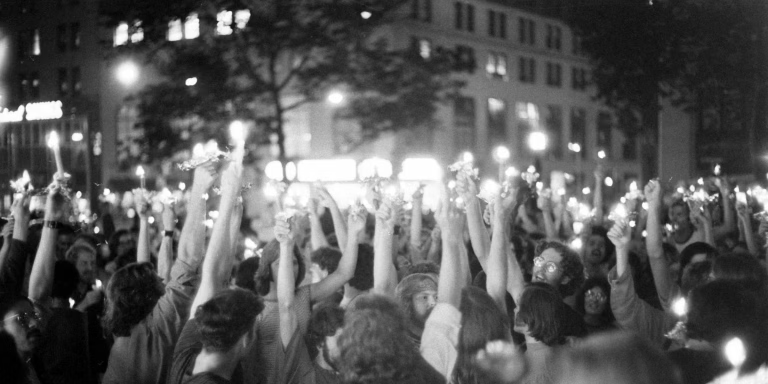
Milk was only forty-eight years old. Just one year earlier, he had celebrated his historic election with tears of joy and the promise of change. Now, candles flickered in the Castro District as thousands of mourners walked silently through the streets, carrying his image and the words that had defined his life: Hope will never be silent.
The White Night Riots
When Dan White was convicted of voluntary manslaughter instead of murder, the queer community’s grief turned to anger. The lenient sentence, which many saw as a reflection of systemic bias, sparked the White Night Riots on May 21, 1979, the eve of what would have been Milk’s forty-ninth birthday.
Thousands gathered at San Francisco City Hall to protest the verdict. The demonstration began peacefully but erupted into violence after clashes with police. Several officers and protesters were injured, and property was damaged, yet the deeper wound was moral. Many felt that justice had been denied not only to Harvey Milk but to every queer person who had ever faced discrimination or violence.
The Movement He Left Behind
Even in death, Harvey Milk’s message did not fade. In the days following the verdict, community leaders called for calm and unity, urging people to channel their anger into action. Out of that pain came renewed energy. New organizations formed to fight for equality, voter registration surged, and young activists took up the mantle that Milk had carried so fearlessly.
Within a year, marches and vigils honoring his memory were being held across the country. His courage had become a rallying cry. He had once said that every queer person who came out was an act of revolution, and that belief lived on in the thousands who refused to return to silence.
Legacy and the Light That Endures

A Legacy Written in Hope
Harvey Milk’s life was short, but its impact is immeasurable. His courage to live authentically and speak truth to power transformed not only San Francisco but the entire landscape of queer visibility in America. He proved that representation matters, and that when one person dares to live openly, countless others find the strength to do the same.
In 2009, President Barack Obama posthumously awarded Milk the Presidential Medal of Freedom, the nation’s highest civilian honor. California now celebrates Harvey Milk Day every May 22, and his name graces schools, streets, and naval ships. Yet his real legacy is not found in plaques or holidays. It lives in every person who chooses honesty over fear and community over isolation.
A Blueprint for Courage
Harvey Milk showed that activism is not just about politics. It is about people… about showing up, listening, and refusing to accept injustice as inevitable. His leadership encouraged queer individuals to step into public life, run for office, and demand visibility. Today, openly LGBTQIA+ officials serve at every level of government, carrying forward the promise that Milk made possible.
His blueprint for change was simple: build coalitions, tell the truth, and never lose faith in the power of ordinary people. In a time when fear and misinformation still threaten progress, his words feel as urgent as ever. Hope, he reminded us, is both our shield and our weapon.
The Light That Still Guides Us
More than forty years after his death, Harvey Milk’s spirit endures wherever people fight for equality, representation, and dignity. His message still calls us to action: to be visible, to be proud, and to keep believing that love and courage can reshape the world.
Each generation faces its own battles, but the light Harvey Milk carried still burns bright. His life reminds us that hope is not fragile. It is a force that grows stronger each time someone dares to live their truth.
If Harvey Milk’s story moved you, we invite you to explore more of our LGBTQIA+ History Spotlights and learn about other trailblazers who paved the way for equality. You can also visit our LGBTQIA+ Resources page for community support, education, and inspiration.