When LGBTQ+ People Are Targeted: What History Teaches Us
There are moments when harm becomes impossible to ignore. Not because it is new, but because it is happening all at once.
Across the country, LGBTQ+ people are facing pressure from multiple directions. Health care is being restricted. Families are being separated. Young people are being singled out. Immigrants are being treated as disposable. Each of these fights is often discussed on its own, as if it exists in isolation.
But for those living inside these realities, the pattern is clear.
This is not chaos. It is convergence.
When LGBTQ+ communities feel under attack, it is not paranoia or exaggeration. It is pattern recognition. History has taught us to notice when harm accelerates, when language hardens, and when certain lives are treated as negotiable.
This piece is not about party loyalty or political teams. It is about ethics, memory, and responsibility. It is about what happens when power turns toward exclusion, and what communities have always done to survive it.
Naming the Moment Without Looking Away
There is a temptation, especially in times like this, to soften language. To wait for clarity. To assume things will settle if we stay quiet long enough.
But clarity does not arrive on its own. It has to be named.
When LGBTQ+ people are under attack, it rarely begins with one sweeping act. It begins with pressure. With restrictions framed as protection. With cruelty disguised as policy. With silence presented as neutrality.
We see it when health care becomes conditional.
We see it when immigration enforcement ignores humanity.
We see it when young people are portrayed as threats instead of children.
We see it when public figures debate our right to exist as if it were abstract.
This is how harm becomes normalized. Not all at once, but through repetition.
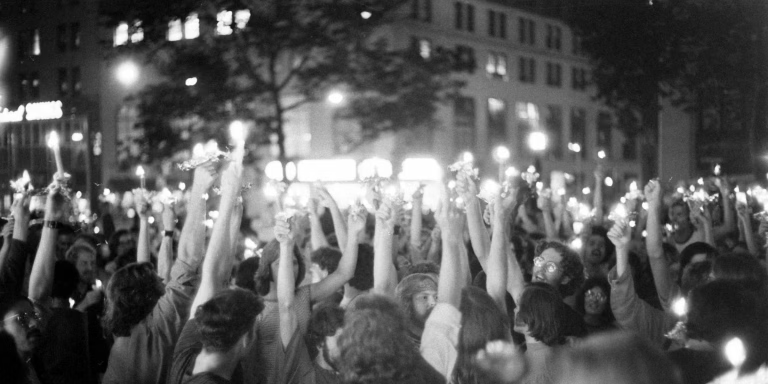
History shows that moments like this are not accidents. They are shaped by choices, by priorities, and by what a society decides is acceptable. The historical records of the Stonewall uprising documented by the Library of Congress remind us that LGBTQ+ resistance has always been rooted in collective survival, not sudden outrage or spontaneous rebellion.
Naming the moment matters because it tells the truth. It refuses denial. And it prepares us for the harder work that comes next.
If you’re enjoying this article, please consider supporting us on Patreon!
Your support helps keep this space free and available, click here to learn how.
We Say Their Names
When we name this moment, we must also name who it has already cost.
Too often, violence against LGBTQ+ people is treated as background noise. A headline appears, then disappears. A life is reduced to a debate, a statistic, or a comment thread. Names are forgotten long before the harm that led to their deaths is addressed.
We refuse that pattern here.
We say the names of LGBTQ+ people who have been murdered in this climate of hostility and dehumanization. We remember trans people whose lives were taken while their identities were questioned, erased, or mocked even in death. We remember that behind every name is a family, a history, and a future that was stolen.
These are not isolated tragedies. They are part of documented patterns of violence against trans people, tracked year after year by organizations like the Human Rights Campaign. The consistency of this harm tells us something important. Violence does not emerge from nowhere. It grows where certain lives are framed as expendable.
It is also important to say this clearly. Naming the dead is not about shock. It is about truth. It is about refusing to let people be reduced to cautionary tales or political talking points. It is about honoring humanity in a system that too often denies it.
There are more names than can fit in one article. That fact alone should stop us. It should unsettle us. And it should remind us that remembrance is not passive. It carries responsibility.
This Is Not New
Moments like this can feel overwhelming because they are often framed as unprecedented. As if something has gone terribly wrong for the first time, and no one knows what to do next.
But this is not new.
LGBTQ+ communities have lived through periods of intense scrutiny, criminalization, and public fear before. Each time, the language changes slightly. The targets shift. The justifications evolve. But the structure of harm stays familiar.
History shows that when a society is anxious or unstable, marginalized people are often treated as problems to be managed instead of people to be protected. Queer and trans lives become symbols, distractions, or warnings. That pattern is visible again and again in the past.
It is important to remember that resistance did not begin when things became visible or acceptable. Long before legal recognition or cultural approval, queer people were already building networks of care, protection, and survival. As queer resistance has always been rooted in collective survival, these efforts were rarely about recognition. They were about staying alive.
Understanding this history does not erase fear, but it does give it context. It reminds us that what we are seeing now fits into a longer story. And it reminds us that communities have endured similar pressure and found ways through it before.
What Resistance Has Always Looked Like
Resistance is often imagined as loud, dramatic, or confrontational. Marches. Speeches. Headlines. But for LGBTQ+ communities, resistance has just as often looked quiet and practical.
It has looked like sharing information when official channels failed. It has looked like housing one another when families turned away. It has looked like caregiving when institutions refused to act. During the height of the AIDS crisis, queer communities built organized care networks during the AIDS crisis long before governments or medical systems responded.
These networks were not symbolic. They were lifesaving.
The New York Public Library’s ACT UP archives document how people organized food delivery, medical advocacy, legal support, and public accountability in the face of mass death and indifference. This was resistance rooted in responsibility. It was survival through connection.
That history matters now because it challenges the idea that resistance must look a certain way to be valid. LGBTQ+ resistance has never been only about visibility or protest. It has been about protecting one another when no one else would.
That kind of resistance does not make headlines. But it changes outcomes.
If you’re enjoying this article, please consider supporting us on Patreon!
Your support helps keep this space free and available, click here to learn how.
Division Is the Oldest Tactic
When harm accelerates, it rarely targets everyone at once. It isolates first.
History shows that marginalized communities are often fractured deliberately. One group is labeled dangerous. Another is framed as undeserving. A third is told to stay quiet for their own safety. Division weakens solidarity, and weakened solidarity makes harm easier to justify.
We see this pattern when trans people are singled out as threats.
We see it when immigrants are treated as disposable.
We see it when young people are portrayed as problems to be controlled.
These tactics are not accidental. They rely on fear and exhaustion. They encourage people to believe that if they stay quiet, or distance themselves, they might be spared.
But isolation has always been the goal.
Historically documented tactics used to fracture marginalized communities show that once division takes hold, accountability fades. Harm becomes easier to deny. Responsibility becomes harder to place. And people who might otherwise stand together are left standing alone.
Understanding this tactic matters because it helps us resist it. When we recognize division as a strategy, we are less likely to internalize it. We are more likely to reach for one another instead.
Accountability Without Partisanship
This article is not about political teams. It is about responsibility.
When harm is happening, accountability belongs to those with the power to stop it. That includes leaders who actively pursue exclusion and cruelty. It also includes institutions that respond with caution, delay, or carefully worded statements instead of action.
Believing in sensible policy does not require accepting inaction. Supporting reform does not excuse spectacle. When leaders have the authority to fix broken systems and choose not to, that choice matters.
Any institution or leader that claims to stand for human rights has a responsibility to move beyond talking points. Words do not protect people on their own. Statements do not stop violence. Real change requires action that improves material conditions for those who are being harmed.
This is not a rejection of politics. It is a call to ethics. Power without accountability is dangerous, regardless of who holds it.
What Rising Together Looks Like Now
Rising together does not require perfection. It requires commitment.
It looks like staying informed without drowning in fear. It looks like protecting trans people when they are targeted first. It looks like refusing language that dehumanizes, even when it is normalized. It looks like showing up for one another in ways that are sustainable.
Community has always been the strongest defense LGBTQ+ people have had. Not as an abstract idea, but as daily practice. Care. Presence. Honesty.
For many people, that begins with finding and protecting community wherever we are. Not everyone has access to large networks or visible spaces. Connection can be small. It can be local. It can be quiet. What matters is that it is real.
Rising together is not about reacting to every headline. It is about choosing one another again and again, even when fear tries to convince us to retreat.
We Have Always Survived Each Other
When institutions fail, communities remember.
This has always been true for LGBTQ+ people. Long before laws caught up. Long before visibility was safe. Long before recognition was offered, queer people survived by choosing one another.
We survived by building families when our own rejected us.
We survived by caring for the sick when no one else would.
We survived by telling the truth, even when it came at a cost.
That history matters now because it reminds us of something simple and powerful. Our survival has never depended solely on permission. It has depended on connection.
Moments like this test more than policy. They test values. They ask who we are willing to protect, who we are willing to stand beside, and whether we believe dignity is conditional or inherent.
There will always be forces that benefit from fear and division. There will always be voices that argue some lives are worth less than others. Those voices are loud because they rely on isolation.
Community answers that isolation.
To rise together does not mean pretending everything is fine. It means refusing to disappear. It means remembering who came before us. It means honoring those we have lost by protecting those who are still here.
We have faced moments like this before. And every time, we have found one another.
That is not nostalgia.
It is a record.
And it is still being written.
If you enjoyed this topic and want a deeper look at how it came together, you can visit the Behind the Blog reflection on Patreon. It is available to both free and paid subscribers and offers extra insight into the research, inspiration, and meaning behind this piece.
Queer and Unbroken is an independent project created with care, intention, and community in mind. There is no outside funding. Every Patreon subscription, whether free or paid, helps keep this space alive so these stories and resources can continue to uplift others. If you feel called to support the work, your presence there means more than you know.